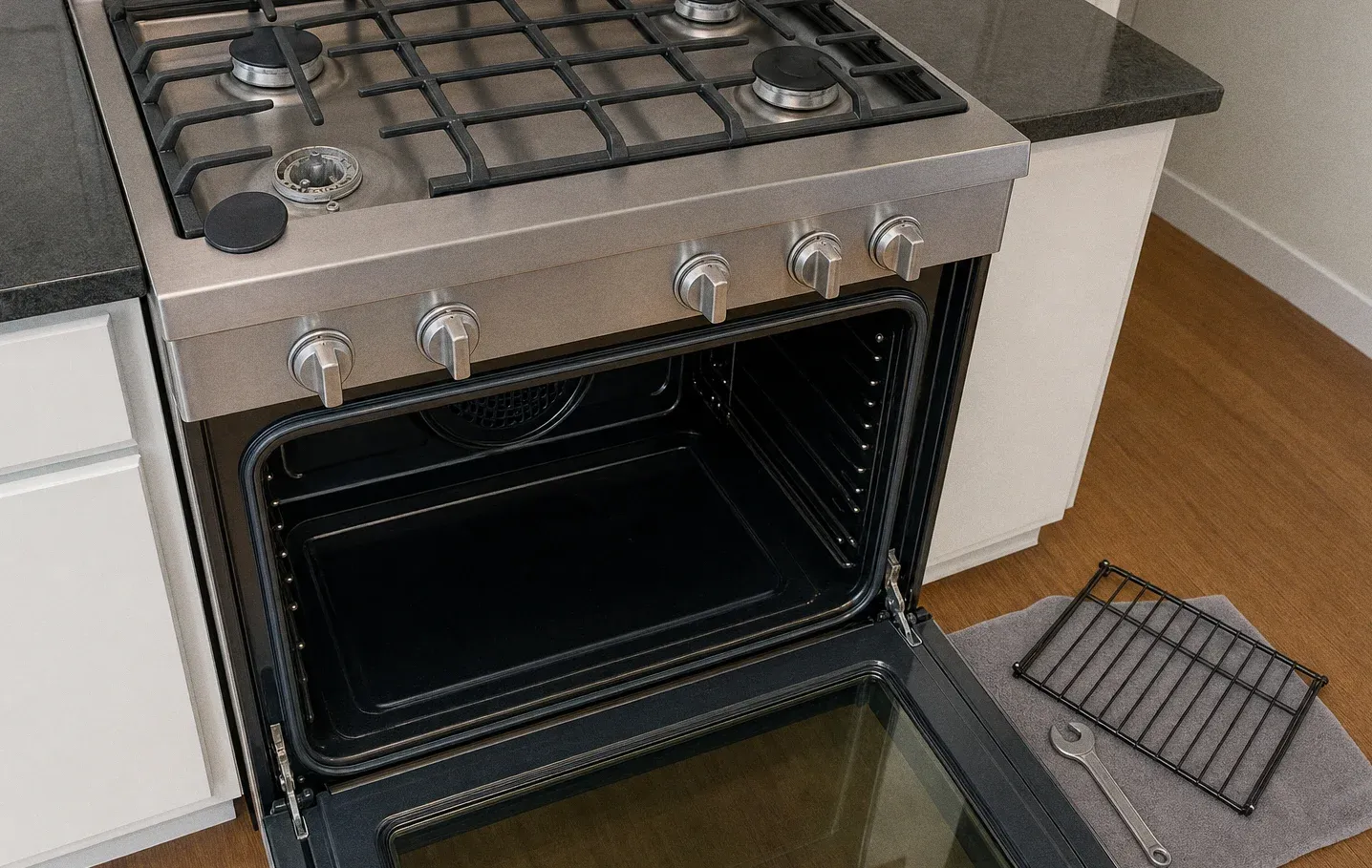
Delayed Lighting on a Wolf Burner in Boston and What It Means
A burner that lights late has been letting gas collect first, which makes it more urgent than one that never lights at all. Check cap seating, blocked ports and a damp or cracked electrode; a gas odour that lingers means leaving the house and calling the utility.
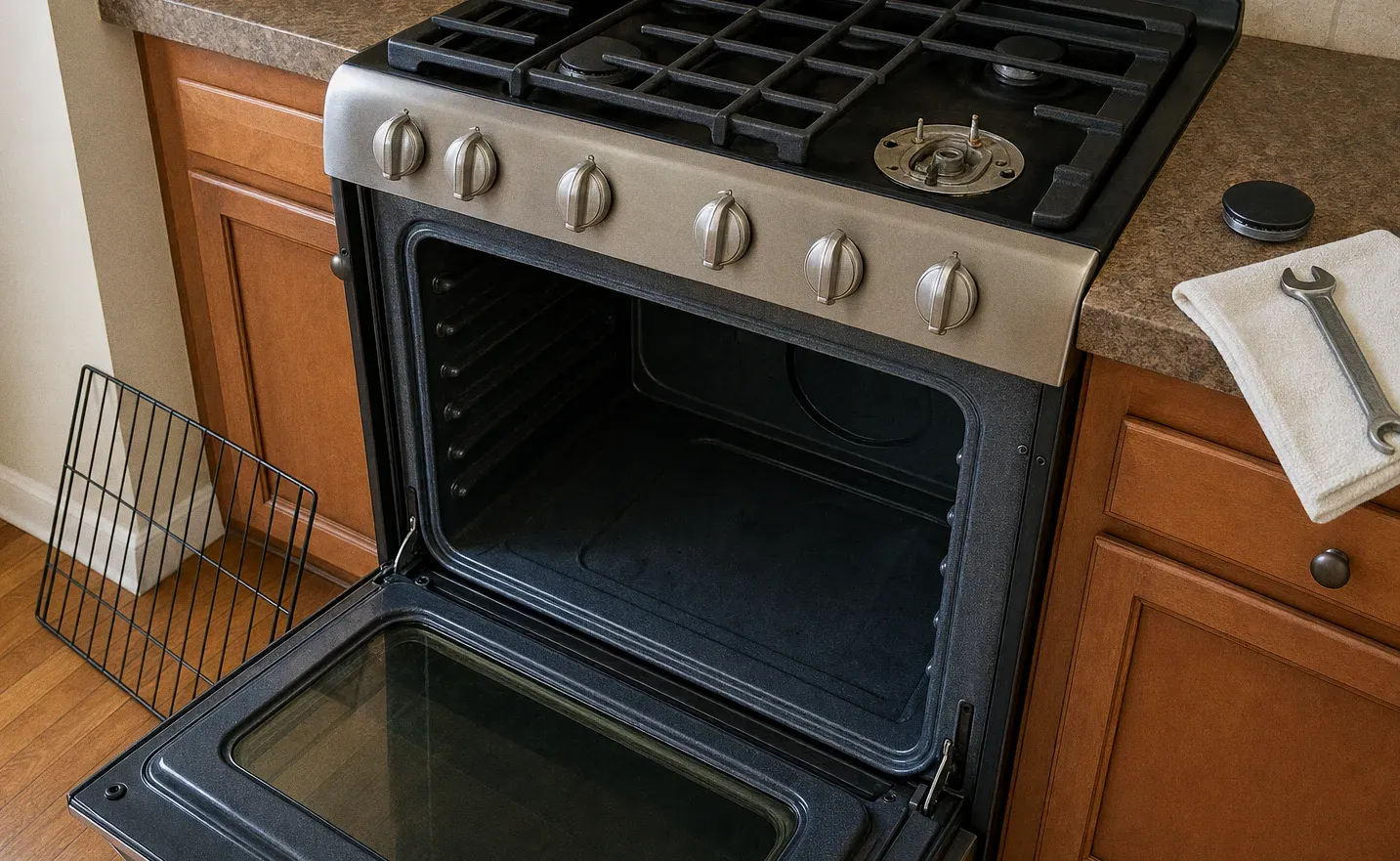
Start with the one thing that overrides everything else in this article. Turn the knob off, and if the smell is still there a few seconds later, stop where you are: no investigating, no sniffing around the appliance for the source, and no ringing a repair company first. Leave the building and call the gas utility from outside. Everything below assumes there is no smell hanging about the room.
With that established: a burner that clicks and clicks before catching, or catches with a small thump, is not the same complaint as one that will not light at all, and it is the more urgent of the two.
The question that halves the problem
Before touching anything, work out how much of the appliance is involved. Turn each burner on in turn and watch. One misbehaving while the rest light promptly is a local fault, and the search is confined to that cap, its ports and its electrode. If the whole set misbehaves together, look instead at what they have in common: the spark module, the gas arriving at the appliance, or the earth the assembly depends on.
There is a third answer people often mistake for the second. On many of these appliances every electrode is driven from a single module, so turning one knob sets all of them clicking together. That is normal design, not a fault, and it catches out plenty of people who assume the whole appliance has gone wrong. What is not normal is clicking that continues with every knob in the off position, which is its own distinct fault and belongs in a separate box from the one you are working through.
Write down what you find while it is fresh: which burners are affected, whether the clicking is continuous or intermittent, roughly how long the delay runs before it catches, and what was happening in the kitchen when it started. Something spilling over, a deep clean, a fitter pulling the appliance out for floor work — in an East Boston triple-decker, where a 30-inch opening was never really meant for the equipment now standing in it, moving the appliance is a two-person operation that disturbs more than it looks like it should. Note it.
Seating, debris and the boil-over nobody mentioned
Most delayed-lighting calls are resolved by things you can put right in ten minutes with the appliance cold. Lift the cap off and look at how it sits. A cap resting a fraction proud of where it belongs — on a crumb, on a burr, on its own alignment pin sitting incorrectly — moves the gas path away from the spark, and a healthy spark that is jumping in the wrong place lights nothing.
Check the ports around the rim. Anything that boiled over and dried in place will block them, and blocked ports give you a flame that lifts on one side and is slow to carry all the way round. Clear them with a pin or a fine wire and a brush, working with the appliance cold and the knob off. Do not open a port out with a drill bit or anything that removes metal; the size is a design decision and enlarging it changes how the appliance burns.
Then there is moisture, which accounts for a striking number of the calls that arrive the day after a kitchen has been cleaned. Water sitting across an electrode conducts, the spark takes the easy route, and nothing lights until it has fully dried. If the trouble started immediately after cleaning, dry everything thoroughly, reassemble the parts properly, and try again later in the day rather than replacing anything. To confirm a cap is seated correctly, refit it cold and turn it gently — it should settle into one position and stay there, not rock or creep round.
Where the spark is supposed to jump
A healthy spark is a fast, regular, bright blue snap that jumps a short gap between the electrode tip and the metal beside it, and you can both see it and hear it in a dim kitchen. That is the test: not whether it clicks, but where the spark is landing. Clicking on its own tells you only that the module is energised.
Look for a crack in the white ceramic sleeve around the electrode. A cracked insulator lets the charge escape to earth before it reaches the tip, so the module clicks away happily while nothing useful happens at the gap. The tell is usually a spark you can hear but cannot find, or one visibly jumping down the side of the ceramic rather than across the intended gap.
Residue does something similar. A film of grease, sugar from a boil-over or cleaning product left in the crevice creates a conductive bridge, and the charge follows it instead of arcing where it is meant to. Both faults produce exactly the same soundtrack as a working appliance, which is why judging ignition by ear is unreliable and why looking at the spark itself is worth the trouble.
A delay is a fault report
A burner that takes several attempts, or several seconds, before it catches is telling you that gas has been flowing for that entire period without being consumed. It accumulates, and then it lights all at once. That is why a delay deserves attention sooner than a burner that simply refuses to work: an appliance that does not light is inert, while one that lights late has been quietly assembling the conditions for a thump you can feel through the worktop.
What is happening in those seconds is that gas is arriving but ignition is not being achieved where it should be — a spark landing off target, a cap out of position, an electrode that is dirty, damp or cracked. Every check in the two sections above applies directly to a delay, and they are worth doing carefully before anything else is considered.
What does not apply is guesswork about the supply or the valves. Gas pressure, valve behaviour and the module’s output are measured, not estimated, and there is nothing about them a homeowner can usefully assess from the kitchen side. If the mechanical checks are clean and the delay persists, it belongs with Wolf Range Repair rather than with another attempt.
What is worth a call
The rule that outranks everything above, stated once more: a gas smell that does not clear is not something to investigate. Everyone goes outside, and the call goes to the utility. That is the one instruction in this article with no exceptions.
Short of that, three symptoms are worth a visit rather than another weekend of fiddling. Delayed ignition that survives a proper clean and dry. Clicking that carries on with everything switched off, which usually means a switch or the module is holding the circuit closed and will not stop on its own. And there is the burner that lights, runs briefly, then puts itself out — again a separate fault, and one belonging to flame sensing rather than to ignition.
What a technician establishes is what the module is actually delivering, how the switches behind each knob are behaving, whether the earth path is sound, and what the supply is doing under load — measurements, not impressions. Wolf Repair Boston covers Roslindale, East Boston and West Roxbury, and Davis Square across the line. The number to call and the booking link are both on this page already; have the model number ready, and be able to say whether it is one burner or all of them.
Asked afterwards
I can smell gas. What should I do?
Leave the building and telephone the gas utility from outside, then stay out until they tell you otherwise. Do not hunt for the source, do not operate switches, and do not book a repair first — a repair company is the wrong first call for a suspected leak. Only once the utility has made the property safe does anything else in this article become relevant again.
It started right after I cleaned the range. Why?
Almost always moisture or reassembly. Liquid across the electrode gives the charge an easier path than the air gap, so nothing catches until everything has dried thoroughly. The other candidate is a cap that went back slightly out of position, which shifts the gas away from where the spark is aimed. Dry the parts, refit them squarely, and try again later in the day before buying anything.
The burner keeps clicking even with every knob off.
That is a distinct fault rather than part of ordinary ignition. Something is holding the spark circuit closed — most often a switch behind a knob that has not opened, or the module itself — and it will not resolve on its own. It is not a cause for alarm, but it does need attention rather than another fortnight of listening to it. Note whether it began after a spill or a clean.