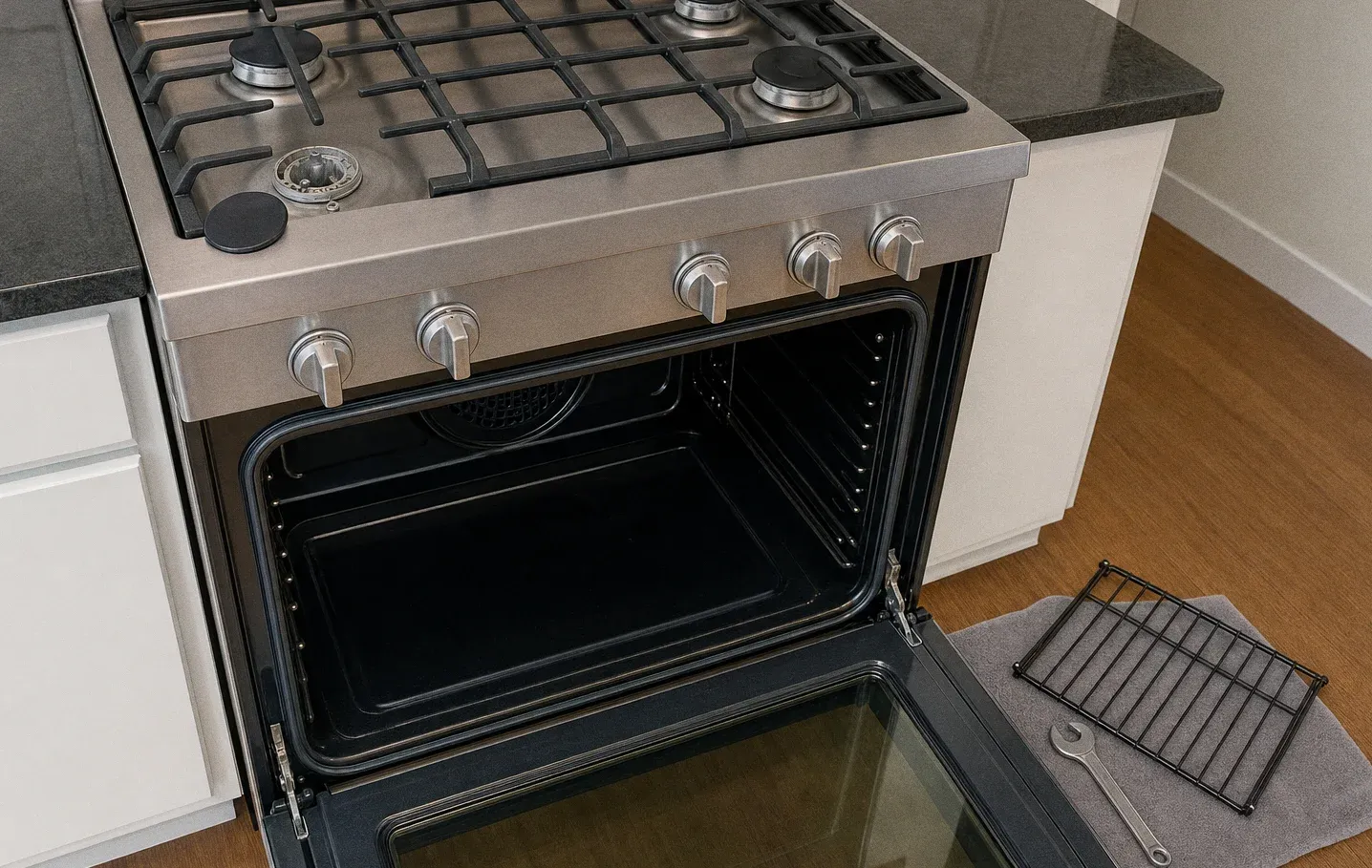
Wolf Oven Heating Element Repair: What Drives the Cost
Fixing an oven heating element costs a flat $95 diagnostic visit plus a firm quote for the part and labor, set by which element failed, how hard it is to reach and whether its relay failed too. On a built-in Wolf oven, the repair is nearly always worth doing.
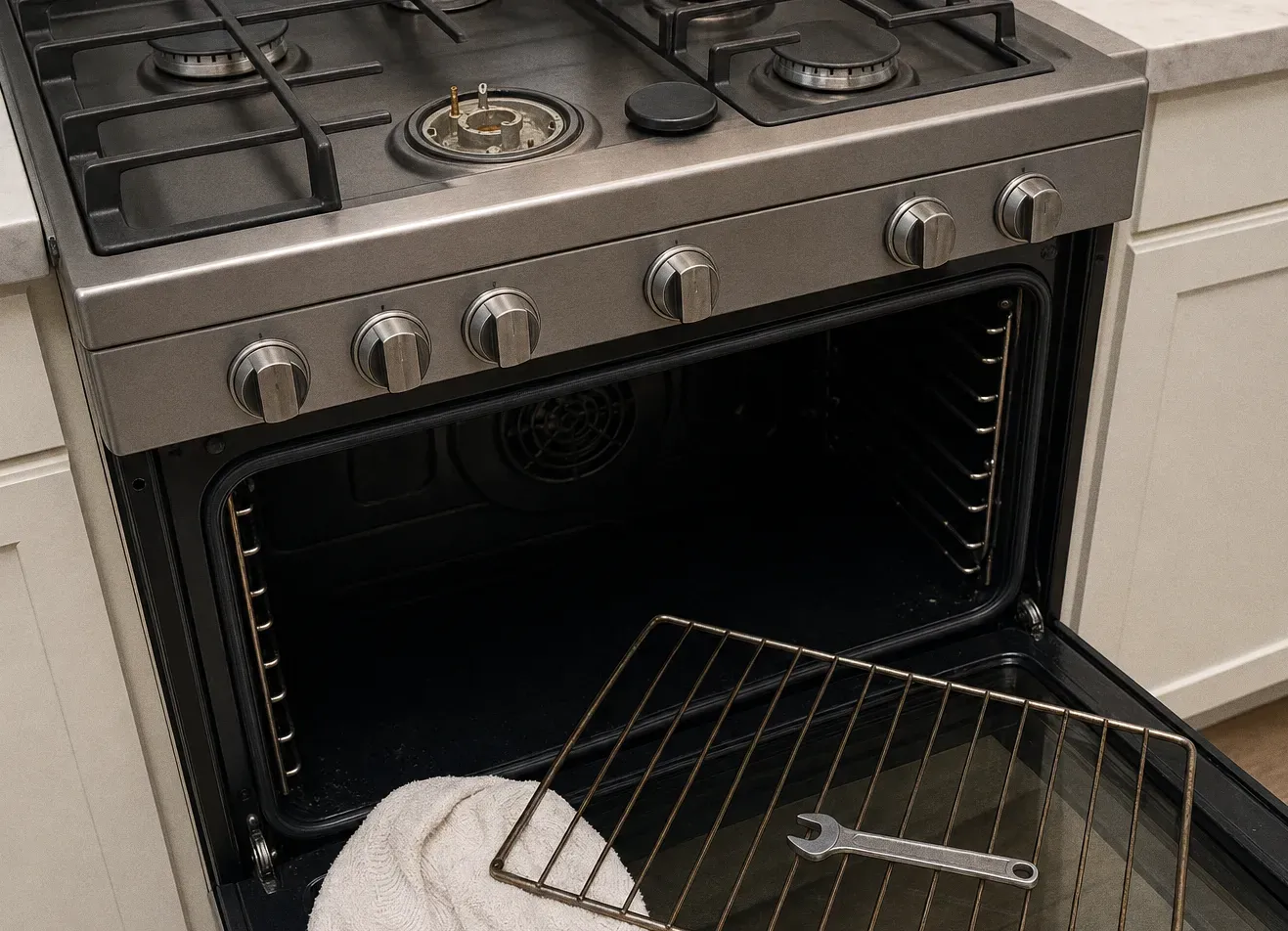
Fixing a heating element in an oven costs the $95 diagnostic visit plus a firm price for the part and the labor, quoted once a technician has tested the circuit and knows exactly what failed. No honest single number exists before that test, because the same unheated oven can come from a burned-out element, a relay that has stopped switching it on, or a fault further up in the controls. On a Wolf wall oven or dual-fuel range, the element is seldom the expensive piece. The bill climbs when the electronics that feed it are part of the failure, and that kind of work typically lands in the $510–$1,660 control board band.
That distinction matters in a built-in kitchen. A Wolf oven sits in cabinetry cut around it, so restoring one part almost always costs far less than starting again with a new appliance.
What sets the price of an element repair
Four things move the number more than the part itself does.
- Which element went. A Wolf oven can carry a bake element low in the cavity, a broil element across the top and convection elements behind the rear wall with the fans. The broil element is in plain sight and comes out from the front. On many built-in ovens the bake element is hidden under the floor panel, and the convection elements sit behind a cover, so both take longer to reach.
- Whether the oven has to come out. When the lower element can only be reached from behind or below, the oven may need to slide out of its opening. That adds time, and on a double oven it adds a lot of weight.
- Whether the element is the cause or the casualty. A relay that sticks closed can keep an element powered until it burns out; a relay that never closes makes a healthy element look dead. Swapping the element without testing the relay is how owners end up paying for the same visit twice.
- What the failure touched on its way out. A shorted element can scorch its terminal wiring or keep tripping the breaker, and both get checked on the same visit.
Parts fitted are factory-approved, and the quote is given before anything is ordered.
When the fault code points past the element
Wolf M Series ovens report trouble circuit by circuit, and the codes separate a worn-out element from failed switching. Wolf’s advice for each is identical: switch the oven’s breaker off for 30 seconds, restore it, and call a technician if the code reappears.
| Code on the display | What Wolf says it means |
|---|---|
| 0021, 0022 | Bake element relay shorted |
| 1021, 1022 | Bake element relay open |
| 0321, 0322 | Broil relay shorted |
| 1321, 1322 | Broil element relay open |
| 0122, 0421, 0422 | Convection element relay shorted |
| 1121, 1122 | Right convection element relay open |
| 0221, 0222 | Bake element DLB shorted |
| 1231, 1232 | Bake element DLB open |
None of these codes says the element itself has failed. They say the part that switches power to it has stuck or opened. That is why a firm figure waits for a meter reading: an element that still reads the right resistance does not need replacing, and the money goes to the switching side instead.
Three element problems that cost nothing
Before you book, rule these out.
The bake stone is still plugged in. Older Wolf L Series wall ovens, built before serial 16000000, refuse to self-clean while the bake stone’s own heating element is connected. The display shows STONE, Bake Stone In or No Bake Stone. Pull that element straight out toward the front of the oven and the clean cycle will run.
Smoke during self-clean. Smoke and a burnt-oil smell during a clean cycle are normal, and they usually come from food or grease left inside, including grease on the broil element. Wipe the cavity out first next time. If the door then stays locked after the cycle, our note on a stuck door latch after a clean cycle explains what to try.
A mode that does not exist in that cavity. On M Series ovens, Stone and Dehydrate work only with their accessories. On E Series double ovens, the lower oven offers no Convection, Gourmet, Stone or Dehydrate mode at all, so a setting that seems not to heat may simply be missing there.
One habit does cause real damage: lining the floor or side walls with aluminum foil, or resting a pan directly on the floor. Wolf says both harm the porcelain interior and void the warranty.
Steam ovens are a different repair
A Wolf convection steam oven, model prefix CSO, heats water in a boiler, so its element trouble shows up as boiler codes. E44 paired with F7 points to the boiler itself: a faulty heating element, a loose flange, heavy scale or a tripped over-temperature limiter. Once errors E43 through E49 have been acknowledged 10 times, the oven shows E54 with F7 and locks its relay board. E69 with F21 means a scaled boiler, a leaking inlet valve or foam in the boiler housing, often after descaling with a solution Wolf does not recommend. Wolf gives owners no fix for any of these, so each one needs a technician.
Is the repair worth it?
For a built-in Wolf oven, almost always. The element is one replaceable part, and the cavity, door and controls around it keep working once power reaches it again. Replacing the whole appliance, by contrast, means buying a comparable pro oven or range, and that costs many times more than any single part.
Repair stops making sense only when several expensive faults pile up together. Even then, ask for each item priced separately so the decision is yours. If the complaint is uneven heat rather than no heat, the usual suspects change: thermostat or sensor calibration typically runs $150–$730, and door hinge, glass or seal work $210–$1,000, with the firm figure after diagnosis in both cases.
Getting a firm number quickly
Note which mode fails, bake, broil or convection, and whether a code appears. Then find the serial tag. M and E Series SO3050 and DO3050 ovens keep it low on the left-hand trim, visible once the door swings open, and a double carries it in its lower cavity; steam and speed ovens put it on the left of the front face frame. A model number starting with SO is a single oven, DO a double and CSO a steam oven.
With those details ready, call Wolf Repair Boston at (508) 401-8451. We are an independent repair service with visits across Davis Square, Roslindale, East Boston and West Roxbury. Our Wolf oven repair page covers the wider service, and owners of a dual-fuel model can read about Wolf range repair.
Asked afterwards
Is it worth replacing a heating element in an oven?
Yes, in almost every case on a built-in oven. An element is a self-contained part, and swapping it brings the whole oven back without disturbing the cabinetry it was fitted into. The sums only turn against repair when several costly parts fail at once, and even then the quote is usually a small fraction of what a comparable new pro appliance would cost.
How can I tell whether the element or the controls failed?
On a Wolf M Series oven the display usually tells you. Codes 1021 or 1022 point to an open bake element relay rather than the element, while 0021 or 0022 point to a shorted one. Switch the breaker off for 30 seconds and back on; if the code returns, the job belongs to a technician and the price will reflect the switching side, not the element.
Can I replace a Wolf oven element myself?
We would not advise it. A wall oven draws power from a 240-volt circuit, the lower element on many built-in ovens hides beneath the oven floor, and reaching it can mean easing the oven out of its cabinet. Misreading the fault is also easy, because a dead relay leaves the oven just as unheated as a burned-out element.
Does the $95 visit count toward the repair?
Yes. The flat $95 covers the visit and the full diagnosis, and it is credited toward the job as soon as you approve the work. You hear the firm price for the element, or for whatever really failed, before any work begins.